Copy Link


what you'll learn
Market Analytics
Rate Fluctuations
Loadboard
Trucking Fundamentals
Lesson details
Understanding What a Load Board Actually Is (And What It Isn't)
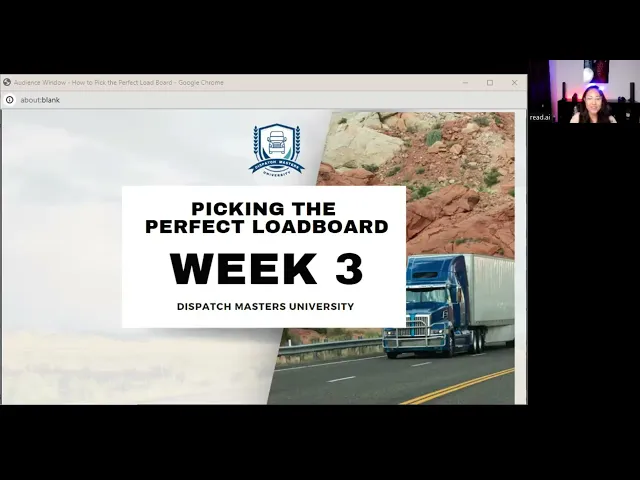
Before a dispatcher can choose the right load board, they need to see it clearly for what it is and honest about what it is not. A load board is a digital freight marketplace: a platform where brokers and, to a lesser extent, direct shippers post available freight, and where carriers and dispatchers search, filter, and make contact to book loads.
In its most basic form, it is a classified advertisement board for commercial freight.
It is not, by itself, a dispatching strategy. It is a starting point. The best carriers use load boards as one tool among many. Building direct relationships with brokers, developing consistent lanes, and working with a professional dispatcher often yields better rates than load board spot market freight.
Load boards fall into three structural categories:
Category One - Premium Subscription Platforms are the industry's dominant freight marketplaces. They charge monthly subscription fees ranging from approximately $35 to $289, offer the highest load volumes, the most sophisticated rate analytics, broker credit verification tools, and integrated features for route planning, mileage calculations, and market trend data. These are the platforms serious dispatchers use as their primary boards. DAT and Truckstop are the only two in this category that matter at scale.
Category Two - Free and Freemium Platforms operate on digital broker models, meaning the platform makes its money on the shipper or broker side of the transaction rather than from carrier subscriptions. Digital freight matching platforms like Amazon Relay, Uber Freight, and CH Robinson Navisphere are truly free because they make money on the broker or shipper side, not from carrier subscriptions. These platforms offer genuine value, particularly for new authorities, budget-conscious operations, and specific freight categories, but typically lack the rate data, broker vetting depth, and search sophistication of premium platforms.
Category Three - Specialty Platforms serve specific freight verticals: auto transport, heavy haul and over-dimensional freight, livestock, expedited loads, and other niche categories that general boards handle poorly. A dispatcher working with carriers in these segments who relies solely on DAT or Truckstop is leaving both load quality and rate optimization on the table.
The Premium Platforms: DAT and Truckstop
DAT Freight & Analytics
The volume leader. The data standard. The board every serious dispatcher knows first.
DAT is the largest freight marketplace in North America by every meaningful measure. DAT posts 500 million-plus loads annually - nearly double Truckstop. Each business day, DAT TruckersEdge lists an incredible one million loads, offering truckers a wide range of opportunities. The platform has operated since 1979, which means its broker network, its historical rate data, and its lane analytics are deeper than any competitor in the market
Truckstop.com
The flatbed specialist. The negotiation platform. The tool that wins on open deck.
Truckstop is DAT's only legitimate competitor at premium scale, and it wins a specific fight decisively. If you haul flatbed or specialized freight, Truckstop may actually be your primary board — it consistently has the deepest flatbed freight volume. One flatbed operator reports that Truckstop handles 99% of his lowbed freight. DAT is stronger for enclosed trailers, but Truckstop owns the open deck market. Luxuria Logisticsgumroad
Truckstop's pricing runs approximately $40 to $199 per month depending on tier, with a feature set that includes real-time broker credit data, load comparison tools, and the carrier vetting infrastructure that makes working with unfamiliar brokers significantly safer. Truckstop stands out for specialized freight because they give carriers more control over how loads are filtered, compared, and booked — their tools are built for truckers running specific equipment or niche lanes, where details and timing matter more than sheer volume. bizquest
Best Equipment Match for Truckstop: Flatbed, step deck, RGN, lowboy, heavy haul, over-dimensional, hotshot with open deck equipment, conestoga, and power-only freight. Truckstop is also strong in reefer and dry van, making it an excellent secondary board for dispatchers whose primary is DAT.
The Value Tier: 123Loadboard and Direct Freight Services
123Loadboard
The best entry-level paid platform. The cross-border specialist.
123Loadboard offers the best value for new carriers at $35 to $65 per month with unlimited searches and credit checks. For dispatchers building their first carrier relationships and working with operators who cannot yet justify premium subscription costs, 123Loadboard provides meaningful freight access, mobile functionality, and broker verification tools at a price point that makes financial sense in the early stages of a dispatch operation
The platform covers van, flatbed, reefer, and hotshot loads with GPS-enabled search functionality and a free ten-day trial that allows genuine evaluation before commitment. 123Loadboard excels for cross-border operations at a time when, per BTS data, Mexico's trucking trade value is now roughly 50% higher than Canada's, driven by the nearshoring of manufacturing to positions closer to U.S. markets. Dispatchers working with carriers running U.S.-Mexico lanes should treat 123Loadboard as a primary board for that specific freight category regardless of what else they subscribe to.
Direct Freight Services
The budget secondary board with real volume.
Direct Freight Services offers a free tier and a paid subscription capping at approximately $34.95 per month — making it the most affordable option among platforms with meaningful load volume. Direct Freight Services has a large volume of loads available every day, with the vast majority of freight posted by brokers. Equipment coverage is broad: van, flatbed, reefer, conestoga, container, specialized, and box trucks are all represented. For dispatchers who want a secondary board that provides a meaningful volume check against their primary platform without the cost of a second premium subscription, Direct Freight Services serves that purpose efficiently. YouTube
The Free Platforms: Strategic Use, Not Strategic Reliance
Free load boards deserve neither dismissal nor overconfidence. Used correctly, they are genuine income-generating tools. Used as a substitute for premium platforms, they are an invisible tax on your carrier's earnings — because free boards often lack real-time updates, offer fewer load postings, and may not provide broker verification or safety tools. Here is how to deploy each major free platform with precision. T
TruckSmarter - Best Free Load Board for New Operations
TruckSmarter earns the best free load board spot because it provides open access to brokered freight without requiring a subscription. Carriers can search, book, and manage loads at no monthly cost, which makes it appealing for new authorities and budget-conscious operators. Over 100,000 loads are consistently available on the platform, and TruckSmarter's integration of fuel discount programs creates a cost-reduction benefit that extends beyond load finding. For a dispatcher whose carrier is in their first 90 days and cannot yet justify a DAT subscription, TruckSmarter is the most complete free starting point in the market.
Amazon Relay - Best Free Board for Dry Van and Box Truck
Amazon Relay is the best truly free load board for established carriers. It charges zero subscription or per-load fees, posts 15,000 to 25,000 loads daily, and offers carrier stability through fixed, transparent rates rather than negotiated spot market pricing. Carriers must be approved through Amazon's vetting process, which requires active DOT and MC numbers and specific insurance coverage — but once approved, the load volume available through Amazon's fulfillment and distribution network is substantial and consistent. Most routes are regional, so drivers will be home more often. YouTubegumroad
The rate structure on Amazon Relay deserves mention because it differs fundamentally from spot market boards: rates are set by Amazon's algorithm and are non-negotiable. In tight capacity markets when spot rates spike, Amazon's fixed rates can be below the going spot rate. In soft markets when spot rates fall, Amazon's consistent rates can actually be above what you could negotiate on a load board. The predictability is the value — not necessarily always maximum rate. For a carrier who values schedule consistency over maximum per-load yield — particularly in urban markets with strong Amazon distribution density — this platform is a legitimate primary freight source. IDCrawl
Best Equipment Match: Dry van 53-foot trailers, box trucks. Amazon does not serve open deck, reefer, or specialized freight categories in meaningful volume.
Uber Freight - Best Free Option for Last-Minute Capacity and Instant Booking
Uber Freight stands out for last-minute loads because it allows carriers to book freight instantly at upfront rates. Instead of negotiating back and forth, truckers can see the price, confirm the load, and keep moving — which makes the platform especially useful when capacity opens up unexpectedly. For a dispatcher managing a carrier with a cancellation or an unexpected empty return, Uber Freight's instant-book model is the fastest path to filling that capacity without the time cost of broker negotiation. It is not a primary freight source for a professional dispatch operation, but it is a valuable emergency tool that every dispatcher should have accessible. gumroad
C.H. Robinson Navisphere Carrier — Best Free Platform for Broker Relationship Building
Navisphere Carrier is C.H. Robinson's carrier-facing platform — and C.H. Robinson is one of the largest freight brokers in North America. Access to their load network is free through the Navisphere app, and the value is less about raw load volume and more about the quality of the shipper relationships behind the freight. Carriers who regularly haul Navisphere loads get genuine value from the integrated ecosystem at zero platform cost. For a dispatcher building a book of business with the long-term goal of direct broker relationships, Navisphere is the free platform that most directly supports that trajectory. IDCrawl
Trucker Path — Best Free Supplemental Board
Trucker Path's TruckLoads feature is most accurately described as a supplemental tool rather than a primary freight source. Trucker Path's TruckLoads feature is ideal for finding freight on the road. It's often used as a secondary board alongside paid platforms. Its value to a dispatcher is as a mobile-friendly visibility check and a lane density indicator — a quick scan to understand what freight is available in a geographic area without the analytical depth of DAT or Truckstop. YouTube
uShip — Best Free Option for Hotshot and Partial Loads
uShip operates on a fundamentally different model than every other platform on this list. Rather than broker-posted freight filtered through a carrier search, shippers post freight directly, bypassing brokers, and carriers bid on loads. uShip operates differently from traditional load boards, allowing free listings while charging a 15 to 17 percent platform fee per transaction. For hotshot carriers and operators running partial truckload or specialty freight — boats, oversized personal property, partial flatbed loads — uShip surfaces freight that simply does not appear on broker-dominated platforms. The platform fee must be factored into rate calculations, but the shipper-direct model means there is no broker margin already extracted from the rate before the carrier sees it. IDCrawl
Lesson 1.5 — Specialty Platforms: When the General Board Fails
The following platforms exist because general load boards — even the best ones — fail specific freight verticals with enough consistency that the industry built dedicated solutions.
Truckstop Heavy Haul Load Board Pro
Launched January 2026, this platform is the most significant new development in load board technology for the specialized freight segment. Designed for oversize and over-dimensional carriers, the platform consolidates permit costs, escort vehicle requirements, route restrictions, and equipment constraints into a single workflow, allowing specialized carriers to evaluate loads more confidently before committing equipment. Dispatchers working with heavy haul carriers should treat this as an essential tool — the pricing accuracy alone, given the cost consequences of a miscalculated OD load, justifies its existence. The Robot Report
Fr8star
Fr8star specializes in heavy haul and oversize loads and has expanded into general freight. The platform includes search filters for flatbeds, step decks, and other specialized equipment, with carrier and broker tiers based on completed jobs and customer feedback. Pricing runs approximately $108 per month for full access, with lighter tiers available. For dispatchers operating in heavy construction freight, industrial equipment transport, or wind energy logistics — industries experiencing significant domestic growth as part of the reshoring wave — Fr8star is the specialty board most likely to surface the high-value loads that general boards handle poorly.
VeriTread
VeriTread provides a free heavy haul load board for shipper-direct freight — oversize loads, vehicles, boats, power-only, and RoRo freight. The platform operates on a shipper-direct model similar to uShip, meaning carriers engage directly with the entities moving freight rather than through a broker intermediary. Load volume is lower than general boards, but the freight quality and margin profile on shipper-direct heavy haul loads is consistently superior to broker-posted equivalents. For any dispatcher whose carrier operates specialized equipment, VeriTread should be in the rotation at no cost.
Central Dispatch
Central Dispatch is the dominant marketplace for auto transport — car hauling, dealership freight, auction loads. Over 16,000 carriers are in their database, which is most of the U.S. car carrier population. They cater for thousands of brokers, manufacturers, dealers, auctioneers, and other industry professionals. A dispatcher representing auto transport carriers who is not using Central Dispatch is not dispatching — they are hoping loads appear by chance. This platform is non-negotiable for that equipment type. Wikipedia
Lesson 1.6 — Equipment-to-Platform Quick Reference
The table below functions as a decision tool, not a substitute for the analytical understanding developed in the preceding lessons. Use it as confirmation of a strategic decision, not as the basis for one.
Dry Van (53-foot enclosed trailer)
Primary paid: DAT TruckersEdge or Power, Truckstop
Free supplement: Amazon Relay, TruckSmarter, Navisphere Carrier
Notes: Highest load volume of any equipment type. Rate negotiation skill matters more than platform choice at this level. Focus analytical energy on DAT's lane rate data.
Refrigerated/Reefer Trailer
Primary paid: DAT Power (strongest reefer data), Truckstop
Free supplement: TruckSmarter
Notes: Seasonal rate cycles are significant for reefer freight. DAT's historical rate data by season and lane is the most valuable tool a reefer dispatcher can access for negotiation leverage.
Flatbed (Standard, Step Deck, Conestoga)
Primary paid: Truckstop (owns this market), DAT as secondary
Free supplement: TruckSmarter, Direct Freight
Notes: Truckstop's flatbed volume advantage is consistent and documented. A flatbed dispatcher running DAT as their primary board is leaving load access and rate leverage on the table by design.
Heavy Haul and Over-Dimensional (Lowboy, RGN, Multi-Axle)
Primary paid: Truckstop Heavy Haul Load Board Pro (launched January 2026), Fr8star
Free supplement: VeriTread
Notes: General boards cannot adequately manage OD load complexity. The permit, escort, and routing cost variables that determine whether a heavy haul load is profitable require specialized platform infrastructure. Invest in the right tools for this segment.
Hotshot (Class 3-5 Pickup, Gooseneck, Flatbed Trailer)
Primary paid: Truckstop, DAT TruckersEdge, 123Loadboard
Free supplement: uShip, TruckSmarter
Notes: Drivers using professional load boards report 23% higher annual revenues compared to those relying solely on direct relationships. Hotshot operators who resist load board adoption leave measurable income on the table. uShip's shipper-direct model surfaces expedited and partial loads that don't appear on broker-dominated boards. Luxuria Logistics
Box Truck (26-foot and under, Sprinter Van, Cargo Van)
Primary paid: DAT TruckersEdge, Truckstop (use equipment filters)
Free primary: Amazon Relay (excellent for this equipment type)
Free supplement: TruckSmarter, Uber Freight
Notes: Box trucks operate differently than traditional trucking equipment, creating inefficiency when drivers spend valuable time scrolling through loads that don't match their equipment. Applying equipment filters on DAT and Truckstop is essential. Amazon Relay's regional load density is particularly strong for box truck routes in metro areas with Amazon fulfillment infrastructure. Luxurialogistics
Tanker (Food Grade, Petroleum, Chemical)
Primary paid: DAT Power, Truckstop
Notes: Tanker freight is underserved by specialty platforms at this time. General boards are the primary resource, and dispatcher expertise in the regulatory and safety requirements for tanker operations is more differentiating than platform choice.
Auto Transport (Car Carrier, Open/Enclosed)
Primary: Central Dispatch (non-negotiable)
Supplement: DAT, uShip for partial or specialty vehicle loads
Notes: Central Dispatch is to auto transport what DAT is to dry van. There is no viable substitute.
Lesson 1.7 — Your Load Board Expertise as a Dispatcher Asset
A carrier who has just received their operating authority and is trying to figure out where to find freight does not know any of what this lesson just covered. They know load boards exist. They may have heard of DAT. They are almost certainly unaware that Truckstop owns the flatbed market, that Amazon Relay is the best free board for their box truck operation, or that a specialty platform launched in January 2026 specifically to address the pricing complexity of their heavy haul loads.
You know all of that now. And the fact that you know it is part of what you are charging for.
When a carrier asks you which load boards you use, the answer you give is not a list of platform names. It is a brief explanation of why you use those specific platforms for their specific equipment, what intelligence you pull from each, and how that combination of tools positions you to consistently find better freight at better rates than they could find independently. That explanation — delivered with the calm confidence of someone who has done the analytical work — is a professional credential. It is part of what separates your service from a carrier who learned to use DAT on YouTube.
Section One Exercise: Select a carrier profile — real or hypothetical — and specify their equipment type, home region, and preferred lane length. Then build their load board stack: primary paid platform, secondary paid or free platform, and any applicable specialty board. Write one paragraph explaining your platform choices to that carrier in language they would understand and find compelling. Read it back and ask whether it sounds like someone who knows the market or someone who is repeating what they read. Adjust until it sounds like the former.
Income Disclaimer: Our course material is provided for educational purposes only and does not guarantee any financial success. Results vary and are dependent on individual effort and circumstances. The examples shown are not typical, and there is no assurance you will achieve similar results. Only hard work pays off!
Share lesson:
About Author
Hi there! My name is Brianna Cobb, and I’m a Corporate Consultant with a passion for growth in the supply chain industry. I turn ordinary companies into client attraction machines with strategic marketing, community engagement and corporate sustainability.
My mission is simple:
Empower businesses to maximize profit while embracing innovation and sustainable practices.
Collaborate with passionate entrepreneurs to craft forward-thinking strategies that align with industry trends and organizational goals.
I’m here because I believe in the power of the transportation industry to transform lives. I’ve seen firsthand how this industry can create financial freedom, flexibility, and opportunity for those willing to learn and grow. The future of freight is calling - and I’m here to help you answer. Whether you’re looking to travel more, spend more time with your family, or build the lifestyle you’ve always dreamed of, dispatching can be the key to unlocking those possibilities.
Be notified of new videos & blog posts as soon as they drop
You've been subscribed!
Comments